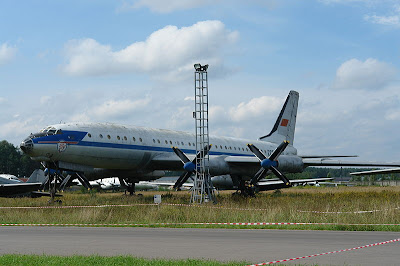
A number of aircraft have claimed to be the fastest propeller-driven aircraft. This article presents the current record holders for several sub-classes of propeller-driven aircraft that hold recognized, documented speed records. (FAI) records are the basis for this article. Other contenders and their claims are discussed, but only those made under controlled conditions and measured by outside observers. Pilots during World War II sometimes claimed to have reached supersonic speeds in propeller-driven fighters during emergency dives, but these speeds are not included as accepted records.
Propeller versus jet propulsion
Aircraft that use propellers as their prime propulsion device constitute a historically important subset of aircraft, despite limitations inherent in their speed. Aircraft powered by piston engines get all of their thrust from the propeller driven by the engine. All aircraft prior to World War II used piston engines to drive propellers, so all Flight airspeed records prior to 1944 were necessarily set by propeller-driven aircraft. Rapid advances in jet engine technology during World War II meant that no propeller-driven aircraft would ever again hold an absolute air speed record. Shock wave formation in propeller-driven aircraft at speeds near sonic conditions, impose limits not encountered in jet aircraft.
Jet engines, particularly turbojets, are a type of gas turbine configured such that most of the work available results from the thrust of the hot exhaust gases. High bypass turbofans that are used in all modern commercial jetliners, and most modern military aircraft, get most of their thrust from the internal fan which is powered by a gas turbine in much the same way as a turboprop. Coupling such a gas turbine with a propeller gives a turboprop engine. The hot exhaust gas from a turboprop engine can give a small amount of thrust, but the propeller is the main source of thrust.
Turboprops
The Tupolev Tu-114, a large aircraft with four turboprop engines, has a maximum speed of 870 km/h (Mach 0.73, 541 mph). The 11,000 kW (14,800 shp) Kuznetsov NK-12 turboprop engines designed for the Tu-95 (and used to power the derivative Tu-114) are the most powerful turboprops ever built and drive large contra-rotating propellers. This engine-propellor combination gives the Tu-114 the official distinction of being the fastest propeller-driven plane in the world, a record it has held since 1960.
Probably the fastest aircraft ever fitted with an operating propeller was the experimental McDonnell XF-88B, which was made by installing a Allison T38 turboshaft engine in the nose of a pure jet-powered XF-88 Voodoo. This unusual aircraft was intended to explore the use of high-speed propellers and achieved supersonic speeds. This aircraft is not considered to be propeller-driven since most of the thrust was provided by two jet engines.
An oft-cited contender for the fastest propeller-driven aircraft is the XF-84H Thunderscreech. This aircraft is named in Guinness World Records, 1997, as the fastest in this category with a speed of 1002 km/h (623 mph, Mach 0.83).[5] While it may have been designed as the fastest propeller-driven aircraft, this goal was not realized due to its inherent instability. [6] This record speed is also inconsistent with data from the National Museum of the United States Air Force, which gives a top speed of 837 km/h (520 mph, Mach 0.70).


